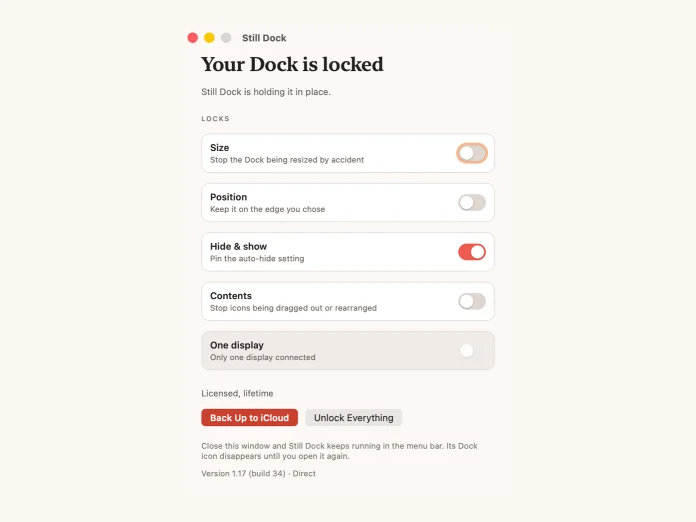
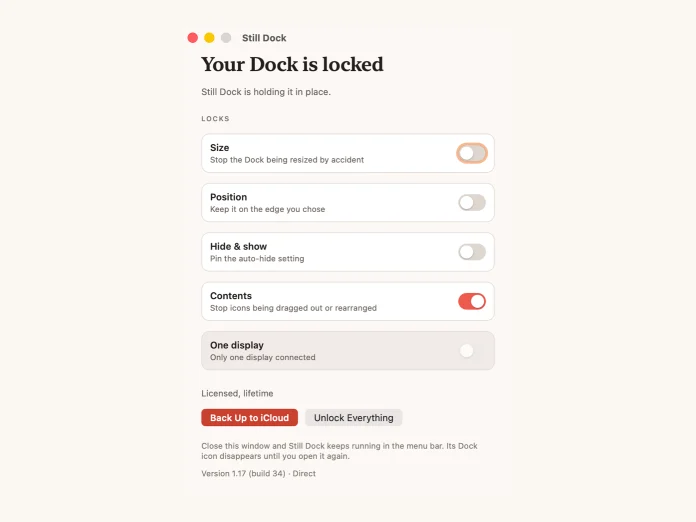
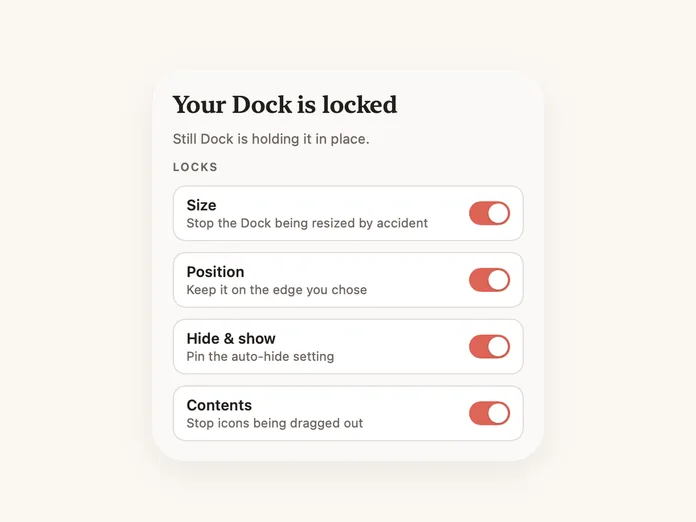
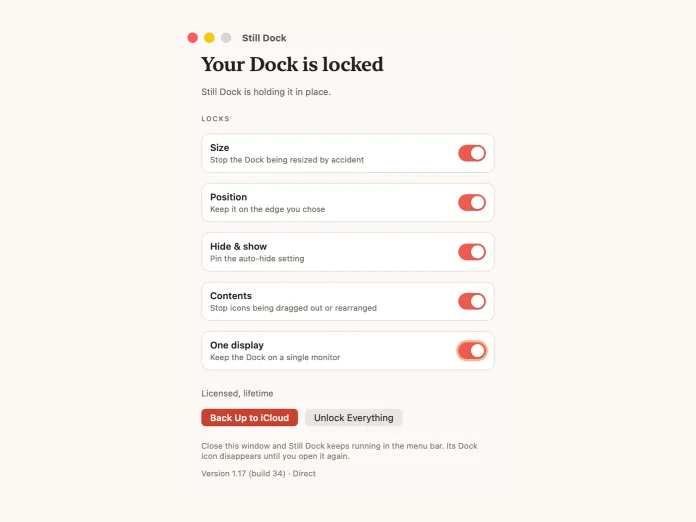
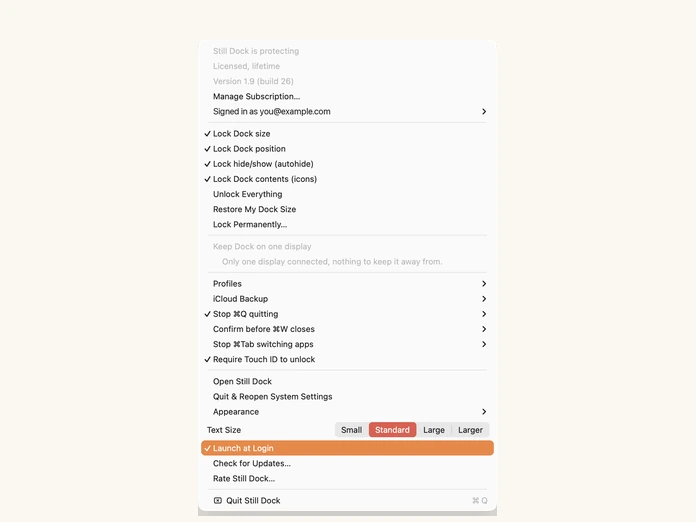
One brush of the divider and every icon is the wrong size. Or the Dock hops to the other monitor, or an app you dragged out is gone. Still Dock locks the size, position, contents and auto-hide exactly where you put them, and guards Cmd Q, Cmd W, Cmd Tab.
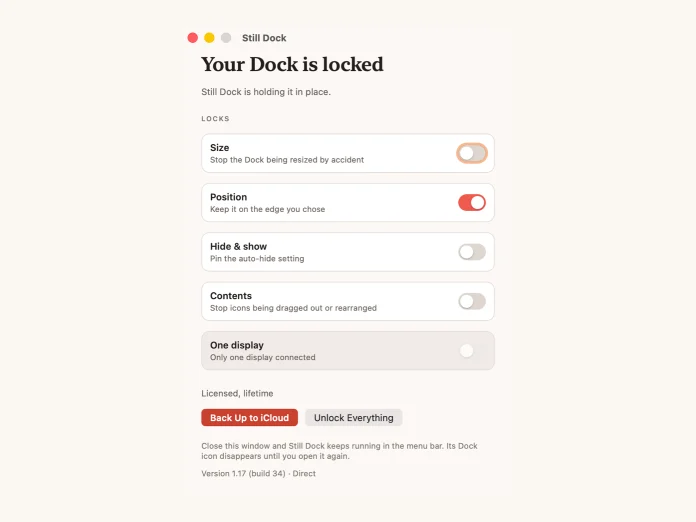
Use the slider to resize the Dock, and drag the Dock itself to another edge. Then turn the locks on and try again.
Demo everything Still Dock does
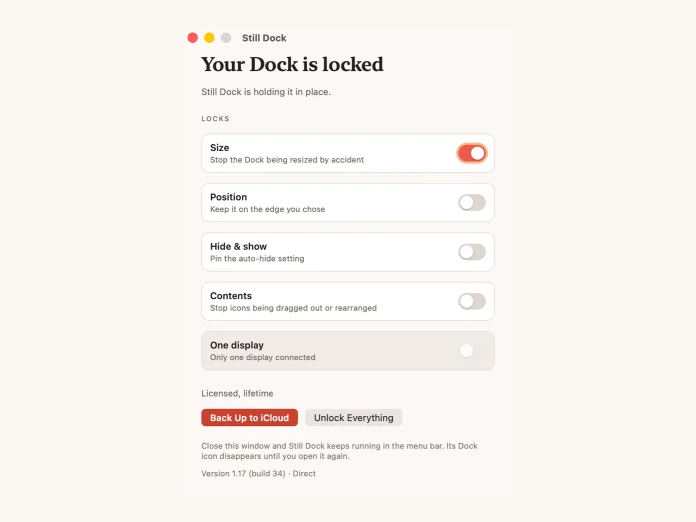
Your Dock is locked
Still Dock is holding it in place.
Locks
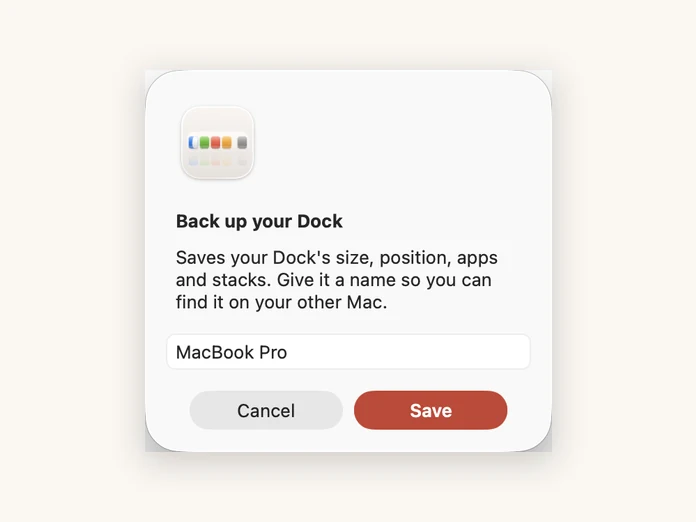
Give this backup a name so you can find it on your other Mac.
Still Dock is trying to turn off the unlock requirement.
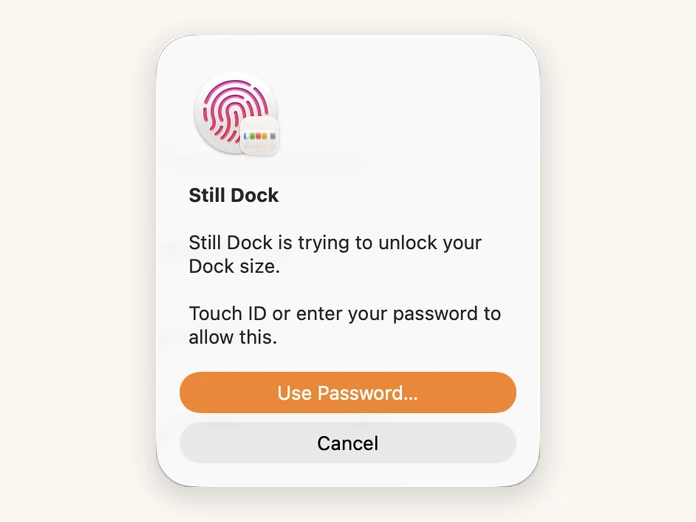
Touch ID or enter your password to allow this.
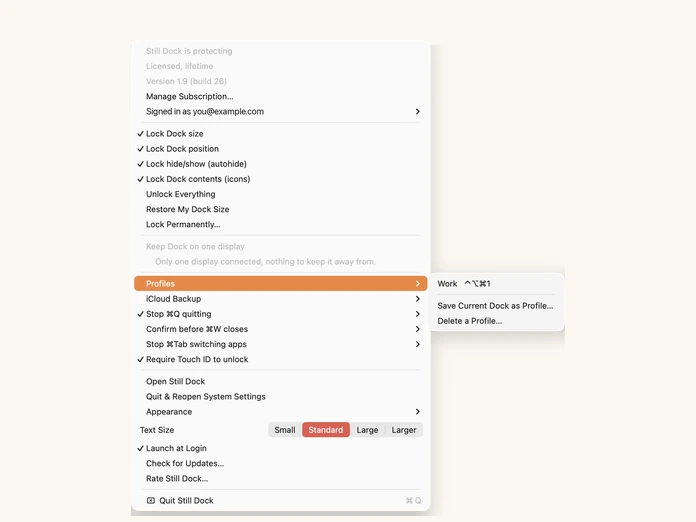
Profiles switch your whole Dock at once. Work, Presenting, Kid Mode.
defaults write com.apple.dock
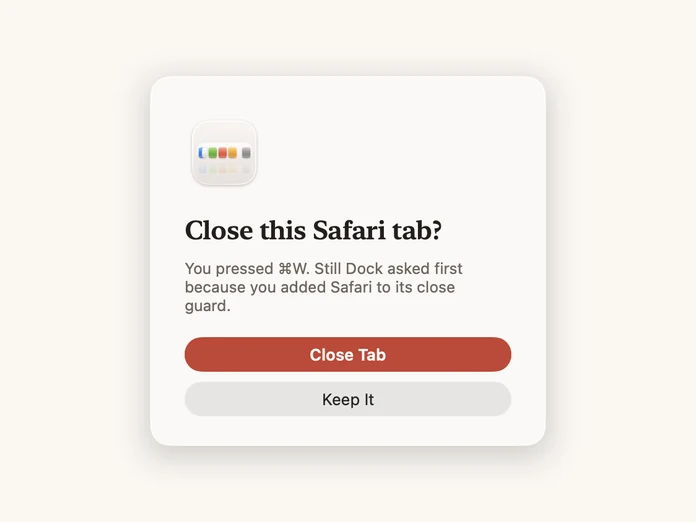
size-immutable -bool falseYou pressed ⌘W. Still Dock is asking first because you added Safari to its close guard.
Pro features shown.
The one everybody hits. No more knocking the divider and rescaling the Dock and every window.

⌘Q sits right next to ⌘W. Set them per app, so the shortcuts still work everywhere else. The installer version holds ⌘Q and shows a confirm box for ⌘W; the App Store version asks you to press again. The installer version can also switch off ⌘Tab, either everywhere or only in the apps you name.

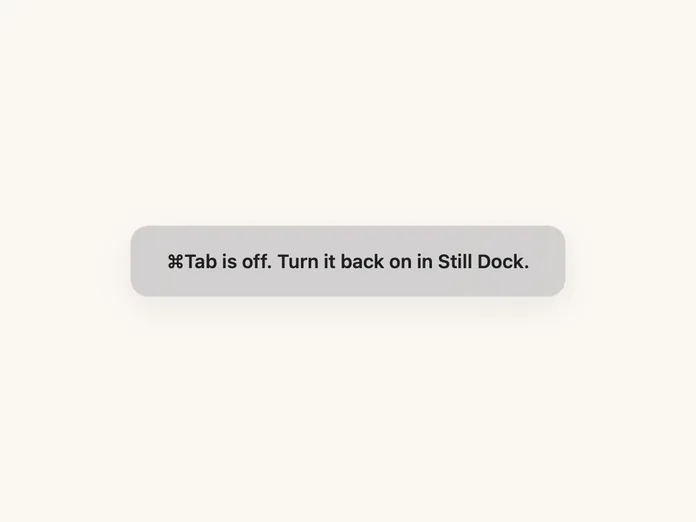
Stop ⌘Tab pulling you out of what you are doing. Switch it off everywhere, or only in the apps you name, so a game or a full-screen document stays put. Direct download only.

Stays on the edge you chose. Bottom, left or right, exactly where you put it.

Pin the auto-hide setting so it can't be flipped by accident or by another app.

Stop icons being dragged out, dropped in, or rearranged. Direct download only.

Every lock as a switch you can see and press, without opening the app. Put it on the desktop, or in Notification Center so it stays in view while you work. Needs macOS 15 or later.

Pin the Dock to one screen so it stops jumping to whichever monitor your cursor wandered onto.

Your whole Dock saved to iCloud: size, position, apps and stacks. A new Mac starts out exactly like your old one. The App Store version backs up your locks only.

Unlock with your fingerprint when you do want to change something, instead of hunting for a setting.

Save a Dock for work and another for everything else, and switch between them with a keystroke. Direct download only.

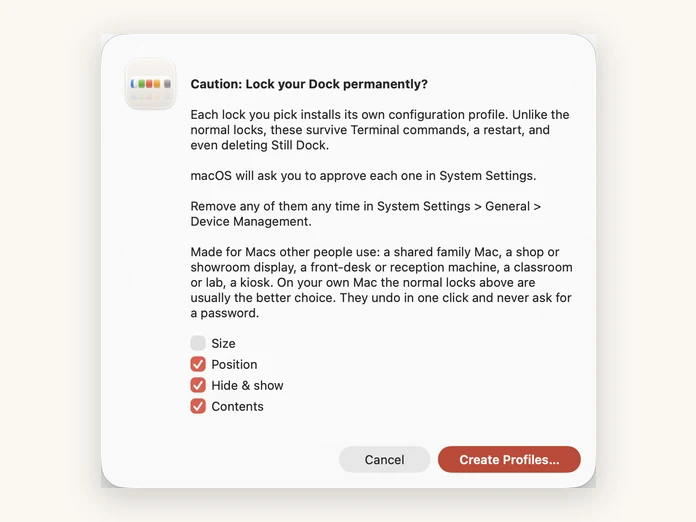
Each lock installs its own configuration profile, so it survives Terminal, a restart, and even deleting Still Dock. Made for Macs other people use. Direct download only.

Starts with your Mac and sits in the menu bar, so your locks are back in place before you open anything.

Hi- I'm Lee. I built Still Dock because I kept knocking my Dock out of shape and could never get it back.
It always happened the same way. I'd reach for something near the bottom of the screen, brush the divider without meaning to, and every icon in the Dock would jump to a different size. Not a disaster, but extremely annoying.
Especially because there's no "put it back how it was". I'd drag the divider by hand trying to feel my way to the size it was before, and it was never quite right.
Not only is it annoying, it kept losing me time. When the Dock changes height, it takes the space my windows were using with it. So every window I'd carefully placed had to be dragged and resized all over again.
That's why I made Still Dock. Set your Dock the way you like it once, flip the lock, and it simply holds still.
Still Dock also stops the dreaded accidental Cmd Q and Cmd W that lost me countless hours of work and lost tabs. Plus, much more.
Check out the Questions section, or use the Message Me button and I'll get back to you within 24 hours. Still Dock may be my favorite Mac app ever, and I know you'll like it, too.
Cheers -Lee
You can also check out my other apps: Reveal the Dream, The Long View, MyLinedChart, Keep the Diff, Copy Shelter, and Prompt Petal.
You can do this yourself in Terminal.
The exact step by step.
Lock the size
defaults write com.apple.dock size-immutable -bool true; killall Dock
Lock the position
defaults write com.apple.dock position-immutable -bool true; killall Dock
Lock the contents
defaults write com.apple.dock contents-immutable -bool true; killall Dock
Lock hide & show
defaults write com.apple.dock autohide-immutable -bool true; killall Dock
Swap true for false to undo any of them. Or use the free command generator to build them for you. Not sure which approach fits? Terminal, profile and app compared.
More than just keeping the Dock still
Flip one, flip them all, flip them back. It remembers the Dock you had before you locked it and restores it when you unlock, quit, or delete the app. No commands to look up, nothing left behind, and the App Store build does it without touching your preferences at all. Plus, so much more.
At A Glance
| What each version includes | Mac installer | Mac App Store |
|---|---|---|
| Lock Dock size | ✓ blocks the drag | ✓ keeps the pointer away |
| Lock Dock position | ✓ | ✓ |
| Lock hide & show | ✓ | ✓ |
| Lock Dock contents | ✓ | ✕ |
| Keep the Dock on one display | ✓ | ✓ |
| Touch ID to unlock | ✓ | ✓ |
| Profiles and hotkeys | ✓ | ✕ |
| Permanent lock, survives deleting the app | ✓ | ✕ |
| iCloud backup of your Dock | ✓ everything | ✕ locks only |
| Stops ⌘Q quitting by accident | ✓ hold to quit | ✓ press twice |
| Asks before ⌘W closes a tab or window | ✓ confirm box | ✓ press twice |
| Desktop widget and Control Center toggles | ✓ macOS 15 or later | ✓ macOS 15 or later, three locks |
| Stops ⌘Tab opening the app switcher | ✓ everywhere, or per app | ✕ macOS will not allow it |
| Works when the Dock auto-hides | ✓ | ✕ stops working |
| Permissions needed | None* | None |
| Volume licensing for teams | ✓ on request | ✕ |
| Purchase once, use either version | ✓ | ✓ |
| Best price | ✓ | ✕ |
| Where you pay | Here | In app |
Both, and they need different things. On your own Mac the point is the accident: one brush of the divider and every icon is the wrong size, with no undo in macOS. The normal locks cover that and come off whenever you want. On a Mac other people use, a shared family Mac, a front desk, a shop display, a classroom or a kiosk, the point is that the Dock you set up is still the Dock next month. There the permanent lock installs a macOS configuration profile, which survives Terminal, a restart and deleting Still Dock. It is the wrong choice for your own Mac and the right one for a machine you hand to somebody else.
Yes, underneath. We put the actual commands on this page rather than pretend otherwise. macOS has had these settings for years and Apple simply never gave them a switch.
What you're paying for is the switch: four locks in one menu, changeable without opening Terminal, that remember the Dock you had before and put it back when you're done. If you'd rather run the commands, run them.
Yes, 7 days, and after that the size lock stays free. The trial starts when you first install Still Dock, before you pay anything, and it is the complete app rather than a limited version, so every lock works and you can be sure before the first payment. Cancel inside the 7 days and you are not charged.
When the 7 days end, locking your Dock's size keeps working for good. The other locks, the keyboard guards, profiles and iCloud backup stop until you purchase.
Monthly and lifetime have no trial. A month is already the shortest commitment there is, and lifetime is a single payment. See Pro.
Every lock you pick installs its own macOS configuration profile. Unlike the normal locks, those survive Terminal commands, a restart, and deleting Still Dock, which is the point: it is built for Macs other people use, like a shared family Mac, a shop or showroom display, a front desk, a classroom or a kiosk.
macOS asks you to approve each one in System Settings. You can remove any of them at any time in System Settings, General, Device Management.
On your own Mac the normal locks are usually the better choice. They undo in one click and never ask for a password.
Yes, and the other way round. One purchase covers both versions, so purchase it whichever way you prefer and use either build, or both, on the Macs you own.
There is no license key to find or type. Sign in with the email you paid with and everything unlocks. If you purchased through Apple, the App Store version unlocks on its own.
Worth knowing because the two builds are not identical. The direct download does more, so a lot of people purchase through Apple for the convenience and then use the direct build on their main Mac.
Apple's rules for App Store apps are stricter than for apps you download directly, and some of what Still Dock does isn't allowed under them.
Both versions lock size, position and hide & show, keep the Dock on one display, and unlock with Touch ID. Direct download adds the contents lock, profiles and hotkeys, the permanent lock that survives deleting the app, and full iCloud backup rather than just your locks. The App Store version also stops working while the Dock is set to auto-hide, and its locks work by keeping your pointer away from the divider rather than blocking the drag outright, so a determined drag can still get through. In exchange it asks for no permissions at all, where the direct download needs Accessibility for two of its features.
The App Store version asks for nothing whatsoever. Everything in it works the moment you install it.
The direct download needs no permission for the four Dock locks either. Two of its features do: keeping the Dock on one display, and the ⌘Q and ⌘W protection. Both are opt-in, so macOS only asks if you switch one on, and everything else keeps working if you say no.
The reason is the same for both: macOS requires Accessibility before any app is allowed to stop a gesture or a keystroke reaching another app, and stopping them outright is what makes those two features work the way they do in the direct download.
No. That's just macOS's standard wording for a Dock setting that's currently locked. It's Still Dock, and it disappears the moment you unlock.
Everything unlocks. Still Dock reverts every setting when it quits and when it's removed. It will never leave your Dock stuck.
No. It doesn't theme, replace or add anything. Your Dock looks exactly as it does now; it just stops moving.
Yes, and it is one of the reasons people reach for it. macOS moves the Dock to whichever display your cursor last touched the bottom of, which is why it keeps disappearing from the screen you wanted it on. Pin it to one display and it stays there.
Yes. Sign in on another Mac and your setup comes back rather than leaving you to rebuild it by hand.
The direct download backs up your whole Dock. The App Store version backs up which locks you turned on, but not the Dock itself.
Every Mac you personally own or use, up to 5. It's licensed to you, not to a machine, and 5 covers every Mac a person realistically uses, and it's there to stop a single license being rolled out across an office.
Seats free up on their own: a Mac that stops checking in releases its seat after 60 days, so replacing a machine costs you nothing and needs no email.
Not on a personal license. If you want Still Dock on more than 5 Macs, or on machines your company owns rather than you, email hello@littlebirdtrading.com and we'll sort out volume licensing. Tell us roughly how many Macs and we'll come back with a price.
Built for macOS 13 and later, on Apple silicon. Most of our testing is done on macOS 26.
Still Dock is in nine languages: Spanish (Spain and Latin America), French, German, Italian, Portuguese, Simplified Chinese, Japanese and Korean, as well as English. It follows the language your Mac is set to.
macOS has settings that lock the Dock. It has no switches for them. They live in four
defaults write commands, they have been there for over fifteen years, and Apple has
never given them a place in System Settings.
So there are three ways to lock the Dock on a Mac, and they are not equal:
Each lock is independent. Lock the size and leave the position alone, if that is all you need. A fuller comparison of all three is in three ways to lock the Mac Dock.
Most people come to this after knocking their own Dock out of shape. The other half of it is a Mac somebody else uses, and that is a different problem with a different answer.
On a shared family Mac, a school or classroom Mac, a library or public computer, a front desk or reception machine, a shop or showroom display, or a kiosk, the question is not whether you can undo a change. It is whether the Dock you set up is still the Dock next month. Icons get dragged out, the Dock gets resized or moved to another edge, and nobody who did it remembers doing it.
The four locks stop all of that, and they gray out the matching controls in System Settings rather than hiding them, so the machine still behaves normally for whoever is using it. Delivered as a configuration profile they go further: they survive a Terminal command, a restart, and somebody deleting Still Dock. That is deliberately the wrong choice for your own Mac, where you want to change your mind, and the right one for a machine you hand to other people.
Whether you manage one classroom Mac or a room of them, the underlying settings are the same
four defaults keys, and they are documented in full in
every Mac Dock defaults command. Setting up a room of them? Locking the Dock on a classroom Mac.